

Putting together plans to visit Oktoberfest in Munich, Germany, can be daunting. We visited the most recent Oktoberfest to report back and answer some of your burning questions.
From what to expect, the best way to get there, and how to reserve a seat in a tent, we've got you covered!

Jump to:
- When does the Oktoberfest start and end in 2026?
- Where is it taking place?
- What's celebrated at the Oktoberfest in Munich?
- Which are the busiest and the least busy days?
- Is there a dress code?
- Do you require tickets?
- What's the Oide Wiesn?
- Do they accept cards or only cash?
- What budgets to keep in mind?
- How many days to plan for the event?
- What are the opening hours?
- What is the best way to get to the Oktoberfest grounds?
- Is it safe?
- Which attractions and entertainment can I expect?
- What are the most popular beer tents at Oktoberfest?
- Do I need to reserve a table at the beer tents?
- What not to do in a beer tent?
- Is tipping customary in the beer tents?
- Why does it say “Wegen Überfüllung kein Einlass” outside the beer tent?
- Is the Oktoberfest family-friendly?
- Are there age limits for attending?
- What kind of foods are available?
- What is Oktoberfest beer?
- Are there Lockers?
- Where is the Lost and Found?
- Is it Wheelchair Accessible?
- What other Oktoberfest related events take place during that period?
- Where to stay?
- What are some words to know?
- 💬 Comments
When does the Oktoberfest start and end in 2026?
The Oktoberfest starts on Saturday, the 19th of September, and ends on the 5th of October in 2026.
The event is kicked off with the parade of the brewery landlords, which commences between the Stachus and the Sendlingertor.
At the Schottenhammel tent Oktoberfest venue, they then proceed with the traditional tapping of the beer at midday exactly, where they will proclaim, “O'zapft is! (aka, it has been tapped!).
From then onwards, the Oktoberfest takes place daily, including on the last day, the 4th of October.


Where is it taking place?
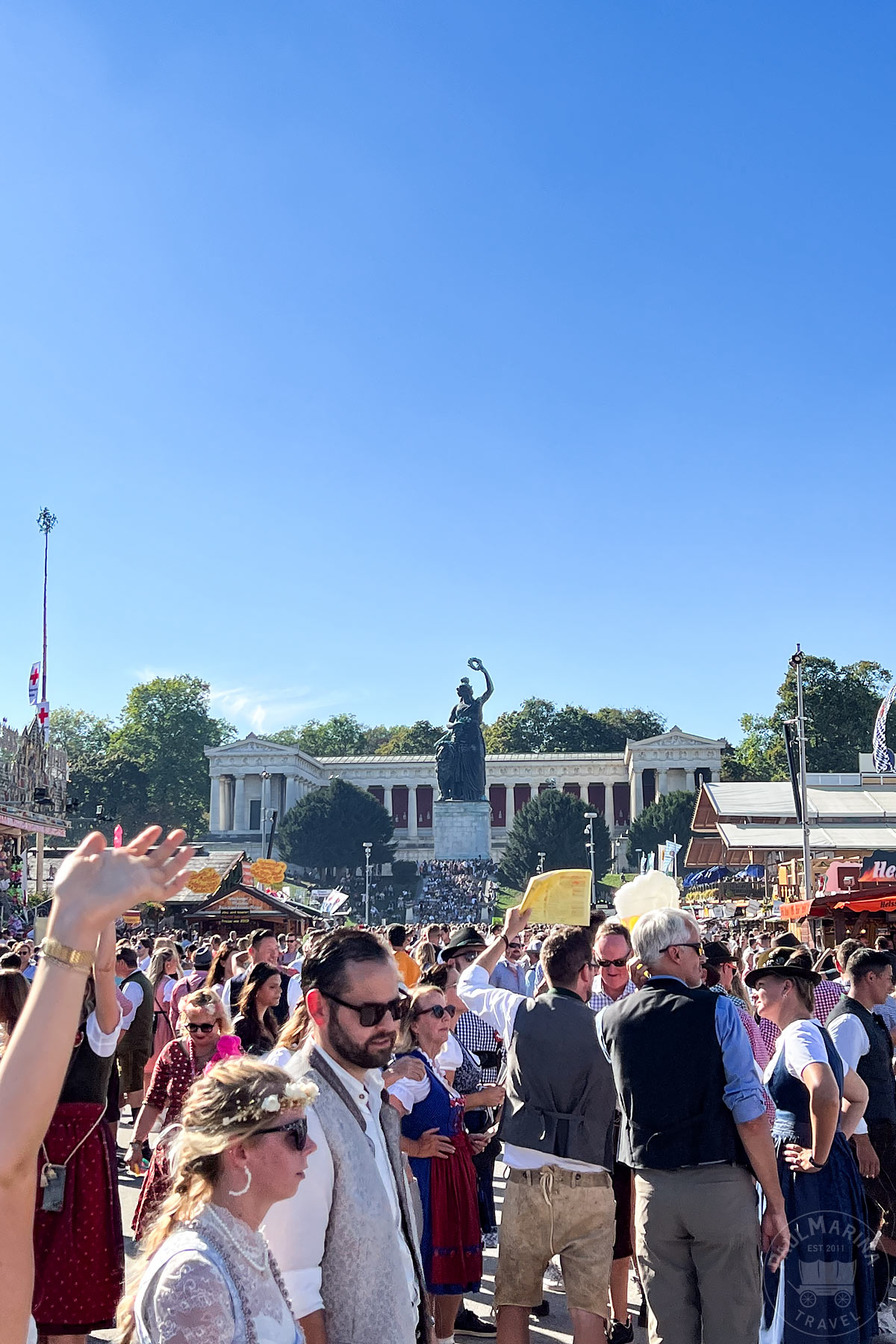
The traditional Oktoberfest venue is the Theresienwiesn, also lovingly called the Wiesn by the Minga (Munich people).
It's only a 30-minute walk or a 15-minute metro (subway/tub) ride, from the city center, the Marienplatz.
What's celebrated at the Oktoberfest in Munich?
The first Oktoberfest came to be due to the marriage celebrations of Crown Prince Ludwig I and Princess Therese of Sachsen-Hildburghausen.
They got married on the 12th of October, and the festivities went on for 5 days and ended with a horse race on the 17th.
To honor the princess, they named the venue the Theresienwiese.
The agricultural association decided soon after to repeat the folk event on an annual basis, and it all developed in time to the Oktoberfest as we know it today.
Originally celebrated in October, they slowly moved the celebrations to the end of September due to weather reasons. It can get really chilly in October!

Which are the busiest and the least busy days?
Weekends at the Oktoberfest are super busy, and you can expect a lot more visitors than during the week.
Especially the 2nd weekend is known as the “Italian week” because that's when groups of Italian men drive across the Austrian mountains to take part in the craze.
Locals generally avoid going to the Oktoberfest on the 2nd weekend altogether because of this.

Finally, the last weekend will be jam-packed because the 3rd of October is a national holiday in Germany.
You have to know that Munich locals all participate in the Oktoberfest. In fact, most Bavarians plan a visit to the Oktoberfest or any of the other autumn harvest festivals, such as the Rosenheim Herbstfest.
The least busy days are on a weekday, and the least busy period is always between 10 am and 3 pm.

Is there a dress code?
No, you can wear normal day-to-day clothes. You don't have to wear local Trachten, Dirndl or Lederhosen. But everybody can wear them, there are no restrictions.
Dirndl are dresses that are worn with a blouse (always wear a blouse!) and an apron. Lederhosen are leather pants traditionally worn by men, but lady Lederhosen are popular and acceptable as well.


The only thing you should keep in mind is do not buy cheap, short cosplay Dirndl or Lederhosen costumes! Follow our Dirndl etiquette and learn how to tie the bow too because it has a meaning.
If you need help with an outfit, head to Inntaler Trachtenwelt, Gössl or Wirkes.
Good-quality dirndls and lederhosen cost $150 and up. If you would rather not invest in that, just wear your jeans and a shirt. There are plenty of people wearing normal clothes at the Oktoberfest in Munich.

Do you require tickets?
No, you can access the Oktoberfest venue freely.
Only the Oide Wiesn, which is the traditional Wiesn, a separate area to the southwest, requires a ticket.
The tickets can be purchased at the entrance gates of the Oide Wiesn, and we didn't experience waiting time on a Saturday.


What's the Oide Wiesn?
The Oide Wiesn means the “old field,” and here you can step back in time and experience the Oktoberfest of yesteryear.
Traditional rides such as the swing ride from 1919 and a retro Calypso give the place a special flair.

We loved the Schuhplattler performance (local folk dance) in the big tent in the Oide Wiesn and the daredevil Motodrom show was a highlight as well.
Most traditional Oktoberfest foods are found in the Oide Wiesn such as Steckerlfisch (stick fish) and horse meat sausages.


Do they accept cards or only cash?
Cash is king at the Oktoberfest. Most vendors do not accept cards at all.
Bavaria has a Cash only mentality, unfortunately. They don't even accept QR code payments.
Avoid the ATMs at the venue because the fees are crazy. Instead, bring enough euros in cash to the venue.

What budgets to keep in mind?
A glass of 1 liter beer will cost you about €15. The rates are set by the tents and will vary from one to another.
Water and soft drinks are frequently sold in deposit hard plastic bottles. You can get €1 or so back for the bottles if you bring the bottles to a stall.
Foods tend to be a bit pricier at the venue, but generally speaking, everything is more expensive during the Oktoberfest weeks in Munich.
Rides, such as the giant wheel and the "Wilde Maus" roller coaster, charge somewhere between €8 and €13 per adult or about €5 per child.
Smaller rides in the Oide Wiesn can be as low as €1.50. Entry to the Oide Wiesn is about €4 per person.

How many days to plan for the event?
A day or two might be enough to immerse yourself in the celebrations surrounding the Oktoberfest.
But fortunately, the city and region have so much more to offer.
You can experience Munich's top attractions and more or plan a day trip from the Bavarian capital to some of the most well-known German sights, such as the Neuschwanstein castle or the Eagle's Nest.


What are the opening hours?
In general, the Oktoberfest tents, including the Oide Wiesn, open their doors at 10 am and shut them at 11:30 pm daily.
Except on the first day, on weekends, and on the 3rd of October (public holiday), the tents open at 9 am.
On the first day, the 19th of September, 2026, you'll get only non-alcoholic drinks until noon because the tapping of the first barrel takes place at noon exactly.
Nonetheless, people queue already at 7 am on a weekend to get into the more popular tents without a reservation.

On popular days and weekends, the tents stop taking admissions at around 11 am and noon already. That means a full stop of people getting access to the tents.
Crowds gather for lunch, and the first free spots are given to new visitors after 2 pm, when the first people leave the tent because, well, people sit, eat, drink, and enjoy.
Bars shut at 11:30 pm, and that's when the last music is played. Only the Kuffler’s Weinzelt and the Käfer Wiesn-Schänke, where the high society hangout, get to stay open until 1 am.

What is the best way to get to the Oktoberfest grounds?
The most convenient way to get around during the Oktoberfest is via the metro/subway/tube, which is locally known as the U-Bahn.
If you are coming from the Marienplatz, you can either take the U3 or U6 to get out at the Goetheplatz and from there walk towards the entry points near the Bavariaring or the Oide Wiesn.
The reason I recommend this route is that it's not that busy compared to the standard route.
The standard route is getting to the Theresienwiese metro stop via the U4 or U5. It's closer to the main entrance, but it's also so much more crowded.
Take a look at the Oktoberfest Wiesn map provided by the city of Munich to help you get oriented.
Alternatively, you can hop on a tram or bus to get to the nearest tram station. You can take a cab or ride an Uber, but you'll get stuck in traffic.
To get from the airport to the Wiesn take the train to the Central station and the U4 U-Bahn (metro/subway) connection to the next stop, the Theresienwiese.

Is it safe?
Keep your belongings with you at all times and take care of yourself because there are people from all over the world coming to this event and a lot of beer is being consumed.
The venue is rather safe because police patrol regularly, but you need to be proactive too.
Pickpockets can lurk and target you, for example.


Which attractions and entertainment can I expect?
You will find rides suitable for kids and adults alike at the venue.
That includes the Ferris wheel, roller coaster, shooting booths, carousel, toboggan, Flip Fly, Skyfall, bumper cars, and Calypso, to name just a few.
Each attraction ticket is purchased at the attraction itself.


What are the most popular beer tents at Oktoberfest?
Bigger at the Oktoberfest means these are the most influential breweries and also the best-visited tents.
This includes 17 large tents, here are some of the most notable tents.
- Schottenhammel — the oldest and where the beer barrel is always tapped first.
- Hofbräu-Festzelt — Super popular.
- Armbrustschützen — By Paulaner.
- Paulaner Festzelt
- Augustiner Festhalle
- Ochenbraterei — Meat is king here!
- Traditional Festzelt at the Oide Wiesn — much more chill with folk dance.
Additionally, you will find 21 smaller tents, which can be equally fun and, at times, less crowded.

Do I need to reserve a table at the beer tents?
You can reserve a seat in a tent, but you do not have to. You should reserve seats if you intend to come on a busy day or if you are visiting with a larger group.
Booking a seat doesn't mean you will get the table to yourself. These are long tables, and you will share the table with someone else.
Avoid third-party sellers, as they will make you pay for things you don't have to.
The city of Munich has an official tent seat booking website. The first reservation seats always go to the regulars.

So, if you need to book a seat, sign up for the newsletter, and they will send you a reminder, and then you need to be quick in grabbing a seat.
The reservation is FREE of COST, but tents ask for a minimum purchase price, which can be 1 liter of beer (about €15) and sometimes also a meal such as a grilled chicken (€15).
Instead of reserving, you can also stand in a queue early in the mornings. They also call this the "Oktoberfest run" because the moment that they open access to the tents, the people, especially locals, run in to grab a seat.
Most locals come on less busy days during the week to enjoy a beer and meal without having to fight for it.

What not to do in a beer tent?
You will be thrown out of the tent if you behave inappropriately, abusively, racistically, xenophobically, or misogynistically.
This also includes sexual harassment and pickpocketing. Cops will be called, and a case will be registered for an offense. They don't mess around with this!
If someone mistreated you, approach the police; they will help you.
You can also fall into trouble in the tents if you drink your 1-liter beer glass in one go. We call this in German “to drink the beer,” ex.
Another offense is to not order anything in a tent or to smoke. There is a clear smoking ban in all tents, and that means tobacco and grass (new German grass laws).

Is tipping customary in the beer tents?
Unfortunately, yes. However, that wasn't always the case, and it's absolutely not the norm that you tip outside the Oktoberfest folks' feast in Munich or Bavaria.
The customary tipping rate right now is 10%.
Why does it say “Wegen Überfüllung kein Einlass” outside the beer tent?
When it says “Wegen Überfüllung kein Einlass” or “Wegen Überfüllung vorübergehend geschlossen,” it means the tents are entirely full and that they don't take any more people. For a while at least.
If you leave your tent to go out for a call or whatever and the tent says all of a sudden “Geschlossen” (closed), it means you can't get in anymore.
Once you leave the tent, you lose your spot in the tent, and it is given to someone else.

Is the Oktoberfest family-friendly?
Yes, the venue is family-friendly, and locals visit the rides and entertainment area with kids.
Are there age limits for attending?
Families with children are allowed to enter the tents. Kids younger than 6 can take part until 8 pm, and kids until 16 need a guardian after 8 pm.
I also recommend looking up local drinking laws for 14 to 18-year-olds.
What kind of foods are available?

All international fast foods and delicacies can be found at the venue, prepared and sold by independent food places.
Nonetheless, I highly recommend trying some traditional Oktoberfest foods. This includes, for example:
- Steckerlfisch — an entire fish grilled on a stick.
- Grilled chicken.
- Bratwurst in a bun.
- White Sausage — Munich sausage specialty made of veal meat.
- Horse Sausage Hot Dogs (you get them in the Oide Wiesn).
- Obatzda cheese dip.
- Sugar coated roasted slmonds.
- Pork Knuckles and Sauerkraut.



What is Oktoberfest beer?
Only six traditional breweries from Munich get to sell their beer at the Oktoberfest.
That's HB (Hofbräuhaus), Hacker-Pschorr, Paulaner, Löwenbräu, Spaten and Augustiner.
As per the EU's Protected Geographical Indication, the beer for the Oktoberfest has to be brewed strictly in Munich.

Traditionally, the breweries prepare the Märzen beer in March (the month is called März in German), which would keep better than most other beers.
As a result, the Märzen beer would be consumed at the last possible date, which is the Oktoberfest. Therefore, the Märzen beer is also known as the Oktoberfest beer.

Are there Lockers?
Yes, 4 different entry points offer paid locker options. The lockers are located at the main gate, at the entrance closest to the Oide Wiesn, and at the Bavaria ring entrances.
The lockers are not physical closed metal lockers; they are a guarded area where they look after the valuables.
You can only pay cash, and they give you a little paper with a number. Take a picture of it, just in case, and keep it somewhere save!
Large bags can't be taken into the event area; you will have to keep them in the locker area.
They will give you a tag at the entrance to the venue for your smaller bags, confirming that they have been checked. Dangerous items such as knives have to be taken to the locker too.
They charge about €7 for backpacks and suitcases and €5 for smaller handbags (if you choose to store them in the locker area).
Children's strollers can be left at the locker area too, but take a cover along because they are stored outdoors.
The limit of liability is just €100, so I don't recommend bringing along expensive items to the venue. In that case, store them at a locker company in town or the lockers at the main train stations are safe too.
The locker areas close at midnight daily.


Where is the Lost and Found?
If you have lost something at the Oktoberfest, head to the Lost and Found office at the Festival Management Entrance.
They are open from 1 pm to 10 pm daily during the event.
Is it Wheelchair Accessible?
Yes, the venue is very wheelchair-friendly, and that also includes rides such as the Ferris wheel and the roller coaster.
All large tents are obliged to keep seats for wheelchair users, on weekends until 2 pm and during the week until 5 pm.
The toilet facilities in the tents and a few outdoors are equipped with ramps. In general, we encountered ramps in almost all areas of the Oktoberfest.

What other Oktoberfest related events take place during that period?
- Oktoberfest parade with the brewery lords — 11 am to noon; it starts between the Sendlinger Tor and Stacchus, Saturday 19th September 2026.
- Traditional Folklore and Marksmen Parade — start 10 am Sunday, 20th September. They walk across the old town square, so you can't miss them.
- Landlord Brass Music Concert — Sunday 27th September, all brass music players play together at 11 am in front of the Lady Bavaria statue.
- Closing Ceremony — Sunday 4th October, with gun salute in front of the Bavaria statue.

Where to stay?
All areas in Munich are relatively safe. In the day, in any case, and at night, normally as well, but due to intoxicated people tumbling around, I recommend being more careful at night.
If you want to stay near the Wiesn, pick a hotel in the Schwanthalerhöhe district or in the area between the Theresienwiese and the old town. But keep in mind that accommodation prices triple during those 2 weeks!
You can reasonably instead pick a room further away along the metro stations, which are still completely within reach but far less expensive, such as Trudering-Riem or Milbertshofen-am Hart.

What are some words to know?
People in Bavaria and Munich speak traditional Bavarian German, which resembles Austrian German.
Expand your Oktoberfest vocabulary with these words:
| Bavarian German | English |
| O'zapft is! | It has been tapped (the first tapping of the beer keg). |
| Wiesn | The name of the Oktoberfest venue. The word translates to “a meadow or field”. |
| Oide Wiesn | Translates to the old Wiesn, which is a paid area with charming rides. It's less busy here. |
| Minga | People from Munich. |
| Maß also spelled Mass | A 1 liter glass, the beer size norm in every beer tent. |
| Zelt | Tent. |
| Münchner Kindl | The Mascot of the city. It's the lady in yellow and black. |
Look up more German words for travelers, or Bavarian German is closely related to Austrian German vocabulary, so you might find this useful on your trip to Munich.


Comments
No Comments