

Cash in king in Germany and Austria and as a traveler to the region, you will need to be prepared for your trip.
I explain where you will need cash and also why cash is still common place.

Cash Only Places
Cash is still an important primary paying option in Germany and Austria.
Card payments are common, but you will most definitely encounter cash only establishments on your trip to the region.
Especially Southern Germany, Bavaria, as well as Austria, are very cash-driven.
Larger shopping chains, government establishments, such as museums and castles, and larger hotel chains always take credit and debit cards.
You will face the cash only problem in rural areas, in smaller independent establishments and at fairs.

The following places are frequently cash only in Austria and Germany
- Food establishments: family-owned restaurants, takeaway places (döner kebab, Curry wurst, Asian places, French Fry stalls), Alms (mountain lodges), smaller beer gardens and beer halls (not the big ones like Hofbräuhaus), small cafés, ice cream parlors rarely take cards.
- Gas Stations: Smaller stations in rural areas hardly ever take cards.
- Souvenir shops or small Boutiques
- Attractions: Also natural attractions such as paid gorge entry points.
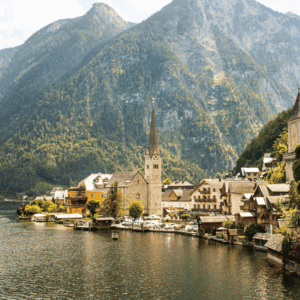
- Boat rentals: including kayak and paddleboards. Think lakes. As an example, the boat rentals in Zell am See or Hallstatt in Austria.
- Oktoberfest: Rides and food stalls, are cash only. This is also the case at other spring and summer fairs, such as at an Almabtrieb or Schützenfest.
- Christmas markets: Christmas market souvenirs are to 99% cash only.
- Other markets, including farmer's market and medieval markets.
- Taxis: You will rarely find a taxi driver taking cards in Munich or Berlin.
- Accommodations: Guesthouses and pensions also prefer direct cash bookings. The tourist tax is often paid separately at the premises during checkout, and the few Euros are paid in cash.
- Parking Lots: Especially outdoor parking lots. Most parking meters take coins only. This is especially true in villages. Many have an online app paying option, which I find unnecessarily cumbersome when I'm looking to just park my car, so cash makes more sense.
- Shopping carts: All shopping carts need to be unlocked with a €1 coin.
- Toll Booths: Smaller toll roads take only cash. One that comes to mind is the Vorderriss toll booth in Bavaria.
- Public Toilets: Many are coin-only accessible, and in Germany, it is common to see a “caretaker” sitting at the door with a plate to give money.
- Lockers: Specific museums require that you lock in your bags. This includes, for example, the Art History museum in Vienna and the Neuschwanstein castle in Germany.
- Bus Drivers may to take cash only if their devices are not working.
- Pay Phones: Although rare, if you need one during a private emergency, you will have to use coins because the old machines were never updated. For a police, fire or ambulance emergency, you can dial without coins.
Possible other places where you can only pay in cash are guided tours, rides and experiences, public outdoor swimming pool, movie centers to just name a few.
This, by the way, also applies to South Tyrol and Trentino in Northern Italy, as these regions used to be part of Austria. This does NOT apply to Switzerland and Liechtenstein, as they love accepting card payments.


Tips
Look out for a signboard with “Keine Kartenzahlung”, “Nur Barzahlung” or “Bar Geld” or one with cards crossed out. That means, the place only takes cash.
I recommend always asking upfront if the establishment is taking cards. We sometimes forget to do this.
Just a few days ago we visited Füssen in Southern Germany and while we were able to pay for a beer with our card, the neighboring stall would take only cash.
We forgot to ask, but my wife had her card in her hand, and the shop owner saw this and directly pointed out that they don't take cards.
So, we went to a nearby bank to take out cash from the ATM. The same bank had a disclaimer that they wouldn't exchange money.


Always keep at least €100 in cash with you. You will need it eventually, either because the establishment isn't taking cash, or because of a “broken” card reader. Remote places (i.e., in the mountains) also have poor card reader range.
Many establishments will only accept your debit or credit card payments if your bill crosses €10, €20 or €30. Our latest experience was at the Ettal monastery shop in Bavaria, where they had a €10 card payment minimum.
Carry always 50 Cent, €1 and €2 coins with you. You will need them to pay for pay parking, to access public toilets or to get a shopping cart in a supermarket.
Avoid €500 and €200 notes because many establishments don't accept them as they are associated with money laundering or people just don't want to break down larger notes. Moreover, shop and hotel chains frequently don't accept these notes!
You can't pay in USD in Austria and Germany. Commercial establishments take only Euros.


All major tourist places and sights normally take credit cards and debit cards. Debit cards are called EC Karte in Germany and Bankomatkarte in Austria. Only European debit cards will work seamlessly in Austria and Germany.
If a place takes Credit Cards, they most definitely accept Visa and Mastercard. Most places do not accept American Express cards in Austria and Germany.
QR Code Payments are still not common in Germany and Austria. That means Alipay, Apple Pay, Google Pay, Amazon Pay, PayPal are not accepted in most places.
Checks are not accepted anymore for payments in Austria and Germany.
Bank transfers or PayPal payments may work for an accommodation, but other places, such as shops, will most certainly not accept this payment.
Forget paying with cryptocurrency in Europe, that's too far-fetched!
Bonus: Many families run hotels and vacation rental owners prefer cash, and they will reward you with a discount if you pay cash.

Why are Establishments Cash Only?
My wife, an Austrian national, has an explanation for the cash only trend in Austria and Southern Germany. She explains:
The plain reason and reality why many establishments are NOT taking credit, debit or QR code payments is because cash is easier to hide from the tax departments. Tax evasion is real, and I call it a scam.
Businesses pay high tax rates and also separately social security contributions in Austria and Germany.
Ultimately, business owners face high back payments, which adds to the challenge of running a business in the region. But of course, this doesn't justify the poor payment choices.
National petitions in the recent past have also made sure that cash remains a major payment method in these regions.
Additionally, political far-right groups in the region associate the taking away of cash payment options with the forfeiture of freedom, and this resonates with the local population.
It's a political game that serves to favor the few.
Cash-only establishments will always claim that they don't accept credit and debit cards because of the fees, but as I emphasize, it's a weak justification.
The rest of the world just adds the fee into the price, or they look towards the future and accept seamless and user-friendly QR code payments.
The fact, that they do not accept QR codes just shows their true motives.
Marina Helene @ MasalaHerb.com



Comments
No Comments