

The Hallstatt bone house is a religious second burial site and one of the largest of its kind in Europe that you can visit.
Intricately hand-painted real skulls from the previous centuries can be seen here.

Jump to:
What is the Hallstatt Bone House?
Displaying skulls and stacking bones neatly into rows has a long tradition in Europe and Christian religions. Especially Catholics and Orthodox, picked up the tradition during the medieval era.
In the case of Hallstatt, it is believed that the burial space was limited. The age-old settlement is squeezed between the lake and the Salzberg mountain, and cremations were forbidden back in the day.
Locals, first only Catholics, but later also evangelists, were buried in the small adjoining graveyard of Hallstatt.
After 10 to 20 years, they would take out the skull and the bone remains from the graves. These were left to bleach in the sun and moonlight for a few weeks until the bones would get the distinctive ivory shade.

These bones were then orderly placed into family groups or ranks in the crypt below the St. Michael's chapel (Michaelskapelle). It is said that the archangel St. Michael watches over the dead.
At the center of this death custom is the house of bones crypt, known as the Beinhaus in German, or charnel house or ossuary.
The practice is also known as a second burial, and it began back in the 12th century in Hallstatt. The last person added to the collection was in 1995. It is believed that the custom could have been a pagan remnant of Hallstatt.
At some point in the 17th or 18th century, the locals started to decorate the skulls by hand-painting on them.

Over 1200 skulls, and half of them are painted, making it one of the largest ossuaries in Europe. The accumulated bones and skulls of the deceased were considered reminders of mortality (memento mori).
Skull paintings are a tradition in the area and can be found in various neighboring regions in Western Austria (Tyrol, Salzburg), Southern Germany (Bavaria), Eastern Switzerland (Graubünden) and Northern Italy (South Tyrol).
The peak of this art form was the 19th century, and some typical regional art styles and motifs are visibly recognizable on regional furniture pieces.

Each skull painting has a meaning. Most have a date of decease written on their forehead, and a few have their birthdates as well. At some point, they even mentioned the exact hour of death and cause of death on the skull.
Others are extensively decorated with intricate floral paintings, ivy leaves, oak leaves, and even snakes. Several legends are told about the symbolism of the painted Hallstatt skulls.
Complete family generations can be found in the charnel house in Hallstatt. This alone makes the UNESCO World Heritage Site of Hallstatt unique in all aspects.
Interestingly, families from Hallstatt still have the possibility to add their skulls to the ossuary. The personal wish has to be mentioned in the testament.

What to expect on your visit?
The bone house is on our top things to do in Hallstatt list.
The ossuary is open to visitors daily, except on religious holidays such as All Saints and All Souls' Day (1st and 2nd November). That's from 10 am to 6 pm.
Tickets can be purchased just outside the charnel house for €2 per adult and €0.50 per child.
Yes, kids can visit the bone house.
We had the experience that they do not take cards, so take some cash with you.


The charnel house is located at the back of the cemetery, right beside the Catholic Church. You can't really miss it.
With the €2 cover charge, you get a small pamphlet explaining the custom and symbolism of each painting.
It goes without saying that you should respect the place. No touching, and, of course, keep your voice down.
We did visit in the summer wearing shorts and tank tops, so they don't impose a dress code.
That said, the ossuary is rather busy in the peak season (July and August), and therefore we recommend that you come to visit early on.

How to get to the Ossuary?
To get to the charnel house, you will need to walk up to the Catholic Church.
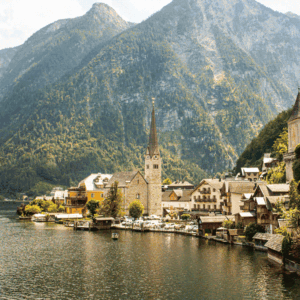
Hallstatt has two churches. The one prominently shown in all the famous Hallstatt pictures is the evangelical church.
The Catholic Church, on the other hand, is situated perched against the Salzberg mountain. (The mountain is called Salt Mountain, Salzberg, and not Salzburg.)

Three different passages lead to the ossuary, which is tucked away behind the church and the cemetery.
The two smaller passages (close to the church) are stairs and cobbled ramps and therefore not very wheelchair friendly. Furthermore, the cemetery consists of small gravel stones.
The steeper and much shorter passage starts just below the church. This one is not recommended in the winter or on rainy, slippery days.


Ultimately, the second passage is much easier to access but a bit longer as well. You can't miss it, as there is a signboard showing you the direction to the church. (It's near the public toilet.).
The third passage is located above the village, and it is known as the Kirchenweg on the maps.
Once you reach the church, huffing and puffing, you are rewarded with a view of Hallstatt and the lake. Walk across the cemetery, and between the church and the cemetery at the mountain, you will see a booth to the ossuary.
Tip: There is a passage (it's a real hike!) that leads from the cemetery further up to the mountain. There are some benches and stops on the way up, and from there you get a fantastic view of Hallstatt.

Are photos allowed in the bone house?
We personally visited the Hallstatt ossuary two times recently.
When we got there the first time in July 2020, it was a secluded area away from prying eyes and spared from Instagram cringe behavior.
Therefore, we received permission to take pictures inside the bone house. We specifically had asked at the counter if we were allowed in with our DSLRs and mobile cams.
When we visited in 2022, they had changed the rules because some people misbehaved. So, no more picture taking in the bone house from now on.
The caretakers told us about some incidents that lacked taste and respect, so I definitely understand why they had to take this road.
Those posting recent images on Google Maps technically broke the rules.
You should know that Hallstatt in general has a substantial tourism problem. It is so well-known that people all over the world just travel to Austria to see this village.
Unfortunately, some people behave as if this small village of 400 souls were a theme park.



Comments
No Comments