

This is a step-by-step guide for all those who are new to using public transportation in any of the European cities.
The aim is to help you navigate with ease, and you will feel more confident with my walk-through.

Jump to:
Step 1: Identify Available Public Transport Types
Most major cities in Europe have a combination of public transport options, and not all cities and countries work the same way.
These are all the major public transport types that you will encounter:
Tram — Railed streetcars or trolleys. They are mostly called trams in Europe, but you might encounter name variations, such as the “Bim” in Vienna. Trams are useful to get around in the cities.

Bus — The most common public transport option and the most accessible one because bus stops are strategically placed.
Use them to get to areas that are not that well served by trams and metros.

Metro — Underground train system that is sometimes called the Tube (London), U-Bahn (Austria/Germany), and in other places the subway.
Not every city has a metro system, and some have smaller connection set-ups. The fastest way to get from one area to another in cities.

Suburban Trains (S-Bahn) — Electronic Hybrid Rail Trains serving metropolitan areas.
Suburban trains are most common in German-speaking countries, and most notably in Munich. Great for day trips and destinations that are not more than 1 hour away.

Regional Trains — Part of a national or private rail company, regional trains take you to places further away.
Most public city tickets don't include this public transport in the city package.

Funiculars — A few cities, such as Paris, Budapest, and Bergamo, have funiculars to get to an elevated area.
Check if your public transport ticket is valid at the funicular. I know the regular Paris public transport is accepted at the Funicular to Montmartre Hill, but the Budapest and Bergamo funicular trips need to be purchased separately.

Ferries — Ferry trips are common in cities such as Venice, at larger river crossings, and at lakes in Europe (Lake Como Ferries). Especially, the ferry rides in Venice are treated like buses.

Step 2: Pick a Ticket Type
Research your ticket options. European cities have similar ticket types, but they aren't the same thing.
Here is what I do: I will look it up online before my trip and type in “official CITY NAME public transport.” One of the first options is the official public transport website of said city. As a side note, there are plenty of third-party website vendors, and they are not the official websites.
Click on their pricing table and compare the offerings. Most cities have a variation of options, but they are not universally all the same. The most common ticket types are:

Single One-Way Tickets — Those can be used to get you on one stretch from A to B. We get these when we don't plan to hop on public transport frequently, such as in smaller cities like Bratislava.
Hourly Ticket — Limitless transfers within an hour after validating the ticket.
Day Tickets — Valid for 24 hours or for the given day until midnight (check the small print). These are handy when you are planning a busy sightseeing day.

48/72 Hour and Multi Day Tickets — The best option if you are exploring a city for some days.
Block of 5 or 10 Tickets — A block of single one-way tickets that are sold as a block of 5 or 10 and that you need to validate each time for every ride. These are at times cheaper than the day ticket and have a longer validity period as well. We tend to purchase a block of 10 tickets in Paris and Budapest.
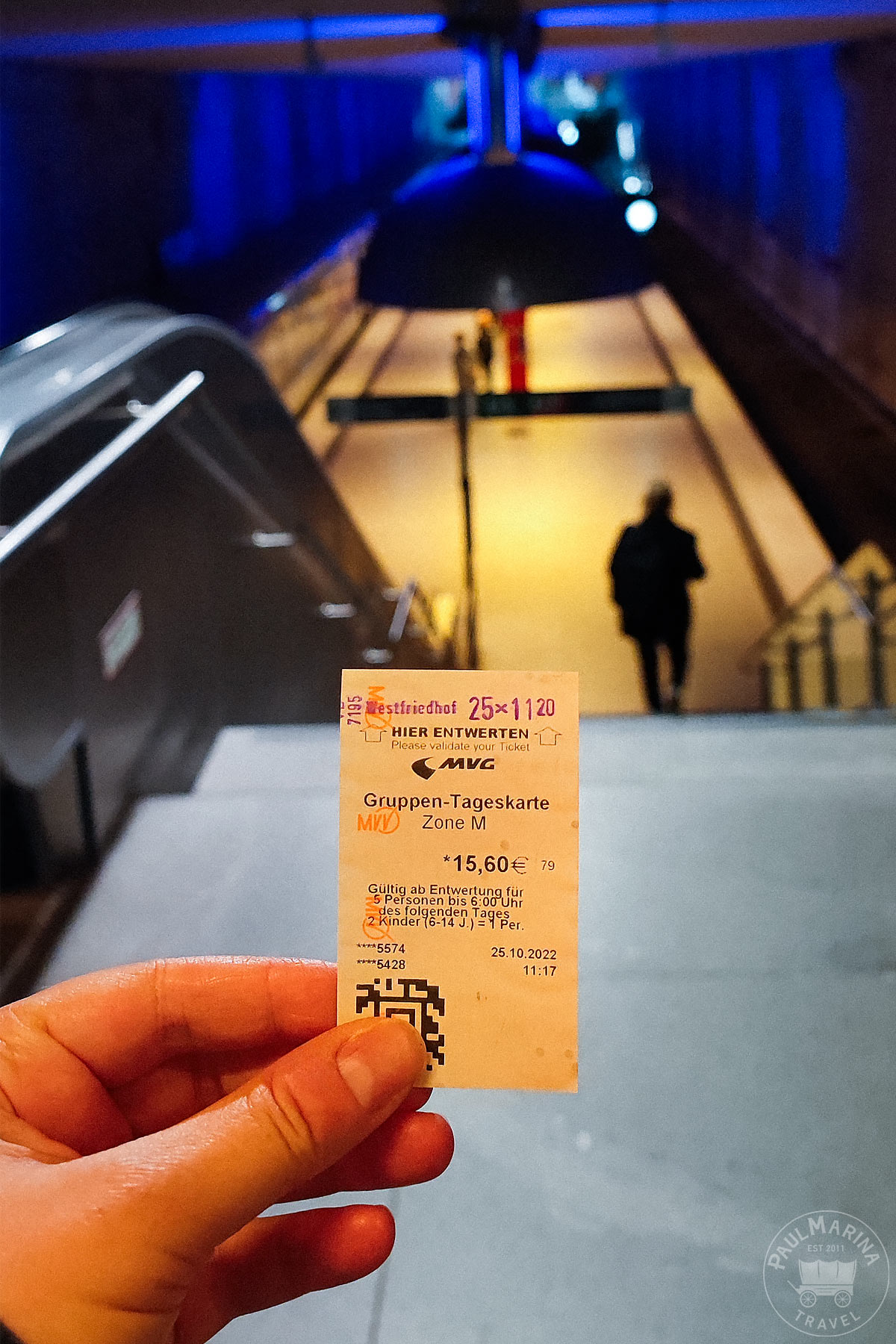
Group Tickets — A single ticket that is valid for 2–7 people. You can save money if these are available. You get them, for example, in Munich.

Step 3: Plan Your Route + Tips
Study the public transport city map before you purchase a ticket so that you can decide on a ticket that suits your needs.
We use Google Maps most of the time, with the directions set in public transport mode.
The map app will spit out the best real-time options from your current location, and you can pick your preferred route and public transport type.

Pay attention to the metro line numbers and colors, tram and bus numbers. Check your transfer option to get from A to B.
Most transportation options have a 3–20-minute waiting period, and you should add that to your equation when you work on your itinerary.
When we are new to a city, we usually prefer riding the subway because it's the least confusing option. Tram and bus stops are not always straight visible, but metro stations are hard to miss.

Besides, you can change metro train lines if you don't leave the station with a one-way ticket. This is most convenient in larger metro stations where several subway lines meet.
Keep in mind that public transport vehicles don't operate 24/7 in European cities. Most train connections run up to 11 pm and 1 am and start again at 4-5 am.

Step 4: Buy Your Ticket
All cities have offline and online ticket purchasing options. We generally still prefer getting our tickets at a ticket-dispensing machine or kiosk.
These machines are found in all major stations, and most accept the local currency in cash, common international cards (credit cards and international debit cards, except American Express isn't always accepted), and tap to pay with your cell phone.

The vending machines are easy to follow, and you can pick your preferred language. In rare cases, the machine may ask you to type in your full name (as seen in Nuremberg, Germany)
Keep in mind that city public transport vending machines and national train service dispensers are two different devices most of the time.
In all major stations, if you are uncertain and you need support, you can get help from a kiosk/counter/information point.
Some cities operate a dedicated public transport app, and a few offer discounted tickets if purchased online (e.g., Budapest).

When purchasing a transportation ticket, look out for:
- Discounted senior and children rates.
- Zone rates — A few cities, specifically in Germany, have zones. The inner zone tickets are cheaper. E.g. If you move between the Munich airport to the city center you will need the ticket that covers all the zones because the airport is located outside the city.
- Special validity timing and conditions. Check if the tickets include all public transport options or only a particular set, and if certain tickets have specific instructions. e.g., Bucharest metro tickets are not valid for tram networks. The Amsterdam Night Bus and ferry tickets need to be bought separately. Hourly tickets in Amsterdam need to be checked in and out.

Step 5: Validating, Stops, Stations, and Directions
Every new ticket has to be validated in all cities before you enter the vehicle of transport. If you don't validate, and they catch you, you will pay a fine.
In most instances, you validate a paper ticket by pushing it into the validation box, and it prints a date and time of validity on your ticket. From now onwards, your ticket is valid.
A day ticket must be validated only once, but if you got a block of 10 one way tickets, you will have to validate each one of them just before you want to use the ticket (not all at once, please!).

Locate your station or stop with the help of Google Maps or by asking locals. Metros are the easiest to locate because of the large M or U (for U-Bahn) sign adjacent to a staircase.
Go to your line. At a larger metro station, you will encounter 2–3 lines. The lines are marked with a specific number and color.

Each line runs in two opposing directions, and the end station is always indicating the direction.
You need to locate your direction first so that you know which train to hop in. Different vehicle line numbers may stop at the same station. Look out for your vehicle number.

Then you will need to know the name of your stop so that you don't forget to hop off. You can count the number of stops too or look at your Google Maps (your blue dot will move along).
If you are taking a tram or bus, you might have to press the stop button to get out at your stop.

How to Read Public Transport Maps
Here is a metro map of the Budapest lines.
Imagine you are at the Kálvin Tér station, and you want to go to the Opera station.
You have to take the blue 3 Metro line in the direction of Újpest-központ change after two stops at Deák Ferenc Tér to take the yellow 1 Metro line towards Mexikói út. The second station, Opera, is your stop.

Essential Tips
Use your phone for Google Maps and to translate tickets and signboards.
A few cities offer special city cards (e.g., I Amsterdam City Card). They include unlimited public transport and discounts to museums. I only ever recommend these city cards if you mean to stay for more than 3 days, and you intend to visit many museums, because of the cost.
Avoid purchasing tickets via 3rd party sellers such as GetYourGuide and Viator. Always purchase tickets directly.

Never forget to validate your ticket. Just because you purchased your ticket, it's not automatically valid from the point of purchase.
Keep your tickets on you at all times because they do random checks, and they are used to people pretending they lost the tickets.
Pay attention to color coded direction signboards and digital screens. Every station usually has a digital screen with the upcoming vehicle line numbers and minutes until arrival.

Your train, bus, or tram number is displayed at the top of your vehicle or on the nearest station's digital screen. You need to identify your vehicle before hopping into a random transport vehicle.
For your exit, count down your stops, look at your Google Maps, and pay attention to the audible announcements. For buses and trams, press the stop button way in advance.
If you took the wrong line or forgot to get off, transfer at the next stop and walk to the opposite platform to go the other way.
Hop-on and hop-off buses are not city buses.
Be mindful of pickpockets and people who pretend to help you at the ticket machine. Especially in Milan, Paris, Rome, and Barcelona.
Luxembourg city (and country) offers free 2nd class public transport, and you don't need to purchase a ticket. Just hop into a tram.




Comments
No Comments